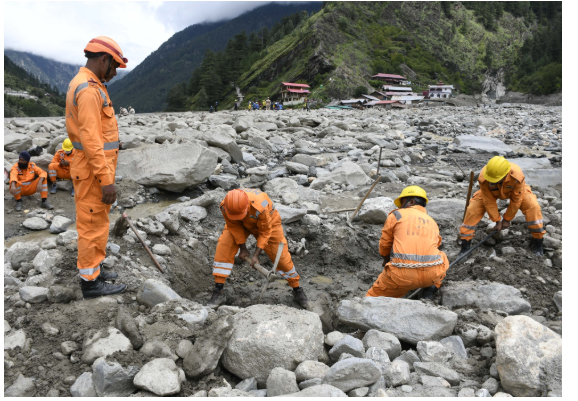
The NDRF and Army team are engaged on a war footing to find signs of life in the rubble spread all around in Dharali. Seeing the way big hotels, host houses, homestays and other buildings in the disaster-hit area have been razed to the ground in the debris brought by the flood, all efforts are being made to find signs of life in the rubble. Heavy machines cannot be used to dig at the place with buildings. Because, even if someone somehow survives, the possibility of saving him will also end. Therefore, NDRF has brought Ground Penetrating Radar (GPR) on Sunday and Rescue Radar on Monday. According to the NDRF team, GPR can detect objects present up to a depth of 50 meters. Its use was started from Sunday. Currently, scanning has been done with GPR in the lower areas. So far, 20 such places have been found at a depth of two and a half to three meters, where buildings or other similar structures have been found. Below three meters, light debris and then solid ground have been found. In such a situation, it is expected that there may be dead bodies there or someone may be found alive. Because, the soil here is marshy and is sinking. Therefore, work is being done according to all kinds of possibilities. Machines are not being used at the places where there are signs of life. These places are marked and digging is being done with hand tools.
To further strengthen the search for life, rescue radar has also been brought down to Dharali from Monday. According to the technical officer of Erica Engineering, who is using this equipment, the rescue radar works on radio frequency.
It is operated at 500 MHz. With this, the condition of a human can be detected at a depth of 10 meters in the debris. If someone’s heartbeat is still there, it will send a signal immediately. Apart from this, rescue radar can detect any movement inside the debris. It was also used in various debris-filled areas of Dharali on Monday. However, no signal could be received through it till evening.
According to NDRF officials working at ground zero, equipment like GPR and rescue radar will continue to be used until the entire debris-filled area is marked.